

Classical Academics
A Poetic Approach to Classical Education
The Curriculum: The Classics of the Western World
If young men are going to learn to love the Lord with all their mind, they need to read what Matthew Arnold called “the best of what’s been thought and said.” Their studies must be rooted in the Western tradition of education.
The seven Liberal Arts, Philosophy, and Theology inform all our studies at St. Dunstan’s, which are rigorous. As they read, write, memorize, recite, debate, and continually discuss the greatest works of the Western past, our young men pour their hearts and minds joyfully into their studies.
A Deeper Glimpse into our Academic Approach
Rather than a shallow and wide attempt at studying all cultures for all times, students at St. Dunstan’s gain a rich awareness of the classical past by reading the great works of the Western tradition. They engage in real scholarly practices instead of thin and uninspiring imitations. They read the Holy Scriptures, the classic stories from Greece and Rome, Beowulf, Chaucer, Dante, the great English Poets, and a wide array of the best short stories and novels the Western canon has to offer.
The study of Greek and Latin gives these young men a strong intellectual foundation in the Classical languages upon which to build up their store of knowledge.
Beyond the Classics, students receive an introduction to the heritage of English language poetry and literature. Once acquainted with the variety and richness the English language has to offer in the prose, verse, and stories of the masters, they can see that some language sounds better and means better. Finally, they learn eloquence through imitation, and the craft of beautiful writing through regular practice.
All of the seven Liberal Arts and Sciences are avenues to Truth, for, as A.G. Sertillanges so aptly noted, “every fact may give rise to a great thought.” Students must be taught to approach mathematics and literature, science and history, writing and song as if each subject holds within it opportunities for joy and wonder.
St. Dunstan’s students study natural philosophy with the same spirit in which they learn their humane letters; they solve equations with the same focus and love they learn by singing in four-part harmony. All truth is connected to the mind of the Creator, and the curriculum employed at St. Dunstan’s, in conjunction with regular practice in the common arts, trains young men to love God with their whole mind, no matter if studying a butterfly, sketching a river, composing a sonnet, or discussing the Battle of Hastings.
The Poetic Mode of Learning
The problem with most contemporary schools isn’t merely what is taught, but how it is taught. Students are viewed as rational receptacles who, in the common metaphorical language, “process information.” But young men aren’t computers, and an education aimed only at their intellects will remain, for the most part, lifeless.
If we want to awaken boys to the wonder of life and the wisdom of the past, they must be ushered into a different pattern of life and richer modes of learning that give them a less mediated experience of the cosmos. Their entire selves — spirit, soul, and body — need to come into contact with what Daniel Kerr calls “the sharp edges of reality.”
“All poetry begins in delight and ends in wonder,” wrote John Senior. The poetic mode of teaching and learning is the primary means of cultivating the right affections in young men. This means that all of their senses must be engaged in the pursuit of truth. They should gaze at the stars, listen to great poems recited, smell the incense rising in church, feast together on the fruits of the earth and their hard labor, and learn the feeling of a dozen worthwhile crafts. Their imaginations need igniting, and this kind of education grips their hearts through the richness of their senses. They thereby gain poetic knowledge of the world.
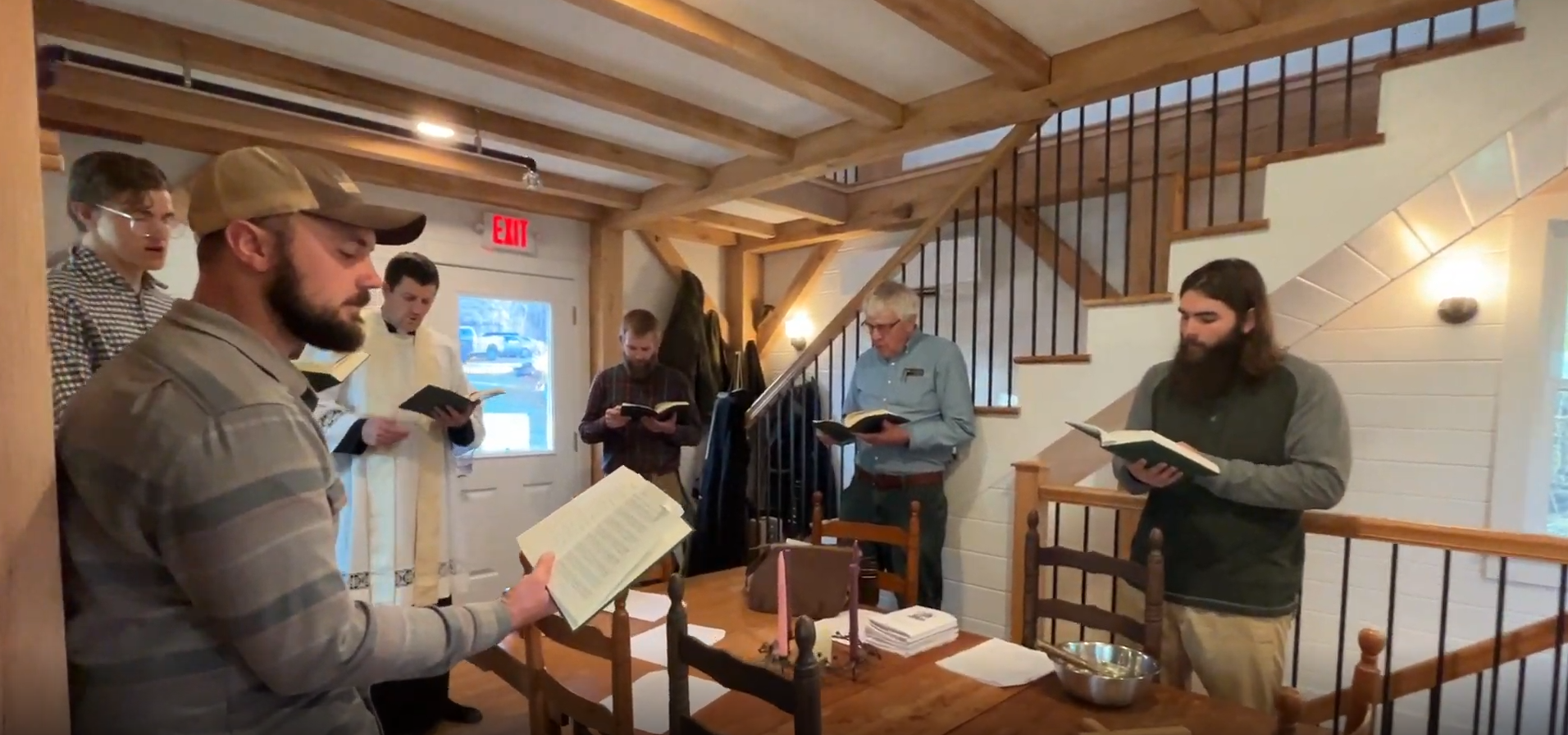
Such poetic knowledge helps boys read both of God’s books. An education delivered through the poetic mode of teaching and learning makes the entire day, from the morning’s chores to sung Compline, a rich array of encounters with the good, true, and beautiful, and so shape their hearts to love what is lovely.
Musical Education
This is true especially through their encounters with music, which are woven into the warp and woof of the school day. As Plato correctly observed, music and the arts help to craft harmonious souls. “We must look for artists and craftsmen capable of perceiving the real nature of what is beautiful,” he wrote, “and then our young men, living as it were in a healthy climate, will benefit because all the works of art they see and hear influence them for good, like the breezes from some healthy country, insensibly leading them from earliest childhood into close sympathy and conformity with beauty and reason… this stage of education is crucial. For rhythm and harmony penetrate deeply into the mind and take a most powerful hold on it.”
Singing together is an act of communion. In our twice-daily use of the St. Dunstan’s Plainsong Psalter, we seek a unity of pitch, volume, and tempo that both reflects and develops a unity of spirit. Meanwhile, harmony in hymnody is, as our friend Ken Myers says, “Love made audible.”
The great anthems of the Church, the best works of the great Western composers, and folk music make up the backbone of a St. Dunstan’s musical education. Students do not consume these works passively. They take up their own instruments and learn to play music for themselves and their fellows, and the day is organized to allow for plenty of interleaved and varied practice.